Tabula Rasa
Quicksilver and Matteo's generation ship contains a Colorless artificial world, formidable telescopes, and nearly all the resources Mars expected to claim as a fleet.
Story so far
The Tabula Rasa's garden is only the heart of a far larger interstellar vessel: an inward-facing world with its own gravity, weather, artificial sun, forests, schools, living quarters, reactors, water plants, and engines. Quicksilver built its central ecosystem because no human community can survive an ocean of darkness on machinery alone. Its children, escorted away at sunset by automaton teachers, are the reason for every immense practical system surrounding them.
The ship's resources carry a bitter strategic cost. Quicksilver confirms that most of his remaining fleet was decommissioned and recycled to finish the Rasa, leaving only defensive vessels he considers necessary until his escape window opens. It is consequently not the navy Darrow came to find. The life raft is also a technologically privileged station: its telescopic array can extend from asteroid craters, combine a long-range multi-part instrument with eight shorter arrays, and use an AI to reconstruct and replay watched parts of the Solar System.
That telescope gives Darrow a view of Mars and Jupiter unavailable to any conventional scout. It shows the enemy's delayed Iron Rain, the departure of Dragon and Dust from Phobos, the Lightbringer's pursuit, and evidence that Volsung Fá has struck Ilium. In refusing to be a warship, Tabula Rasa nevertheless becomes the intelligence platform from which Darrow finds his next campaign.
Appearance
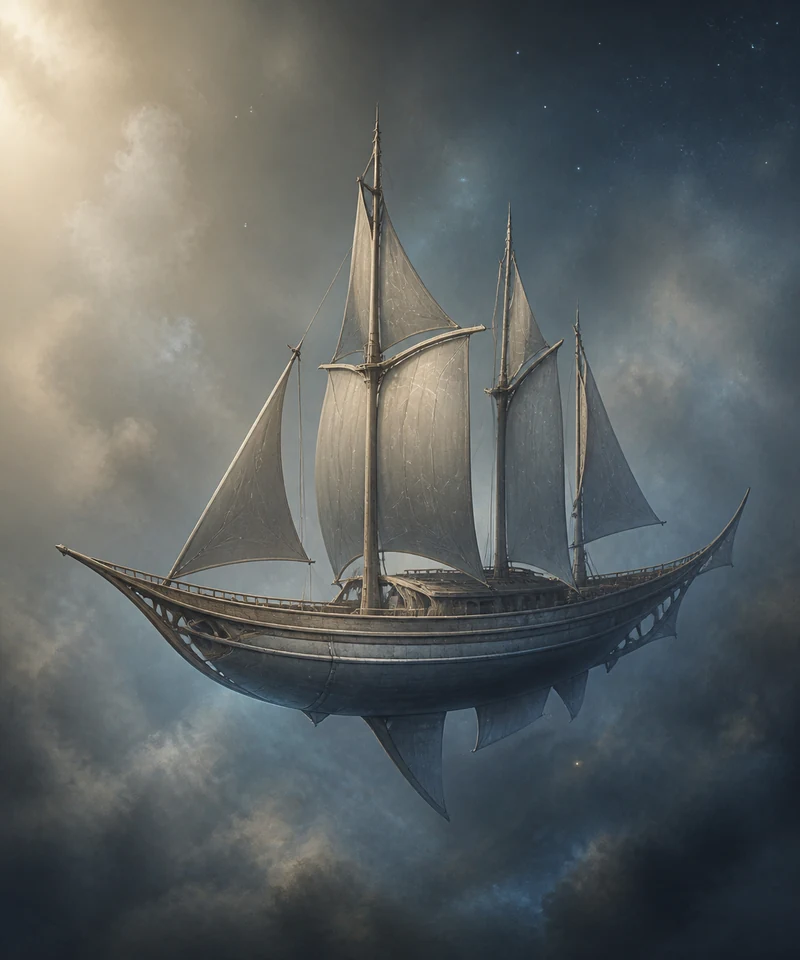
A vast generation ship concealed in a hollowed asteroid, its inner ecosystem curving around an artificial sun. Its exterior includes crater-mounted telescopes and a multi-part, tornado-like metal-and-glass array tapering into a suspended spherical viewing chamber.
Role
The Tabula Rasa is an escape vessel whose refusal of Mars's needs is offset only partly by the vision, repairs, and intelligence it can give Darrow before it leaves the system.
Relationships
Sources — 2 recorded facts, by chapter
- A concealed interstellar generation ship built by Quicksilver and Matteo to carry Colorless children beyond the Solar System and the hierarchy consuming it.
- Quicksilver and Matteo's generation ship contains a Colorless artificial world, formidable telescopes, and nearly all the resources Mars expected to claim as a fleet.